Keter Store It Out Instructions: Complete Guide for All Models (Max, Ultra, Ace, Midi, Pro)
[social-share]
If you’re staring at a pile of resin panels and can’t find the instruction booklet, you’re not alone. The Keter Store It Out range is one of the most popular garden storage solutions in the UK.
That means many people have lost the manual, bought a second-hand one, or just want to know what assembly involves before delivery. This page covers assembly for all five main Store It Out models: Max, Ultra, Ace, Midi, and Pro.
Which Model Do You Have?
Before anything else, work out which model you own. The model name is usually printed on the box, on a sticker on the underside of the lid, or on the original receipt. If you bought it second-hand and have no paperwork, use the dimensions table below to identify it.
| Store It Out Midi | 132 x 71.5 x 113.5 cm | 880L | £100 to £130 |
| Store It Out Max | 145.5 x 82 x 125 cm | 1200L | £160 to £200 |
| Store It Out Ace | 145.5 x 82 x 123 cm | 1200L | £150 to £190 |
| Store It Out Pro | 145.5 x 82 x 125 cm | 1200L | £160 to £200 |
| Store It Out Ultra | Approx. 185 x 90 x 130 cm | 2000L | £250 to £350 |
Dimensions are approximate. The Max, Ace, and Pro have similar 1200L footprints. To identify your unit, check if it has gas struts (Ace) or a piston-assisted lid (Max).
Where to Download the Official Manual
Keter hosts PDF manuals for all current models on their UK site. Visit keter.com/en-gb and search for “assembly instruction manual” or go to the support section. You can also find PDFs via:
- ManualsLib — search “Keter Store It Out” for your specific model
- Argos product support — if you purchased from Argos, search your product code
- Keter UK customer support: CSUK@keter.com or +44-121-506-0008
The steps below are a practical guide for each model. They follow the same general sequence as the official manuals, but are written to be easier to follow mid-build.
Keter Store It Out Midi: Assembly Instructions (880L)
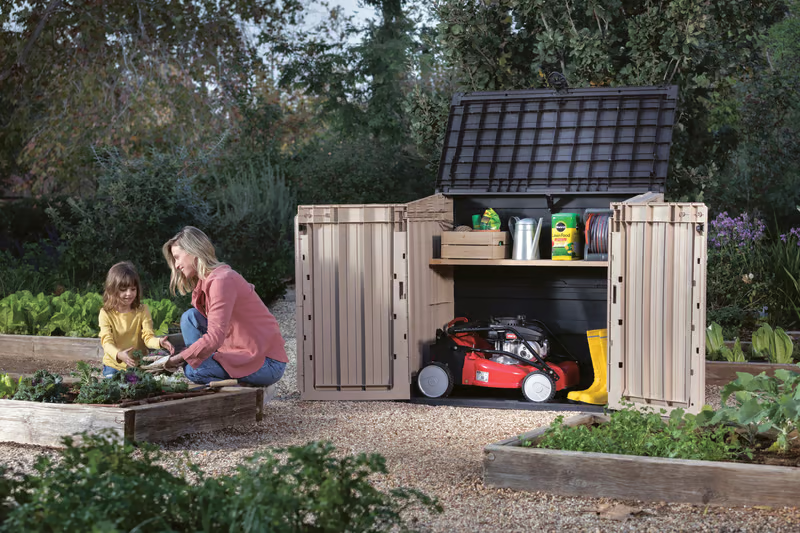
The Midi is the smallest model. It fits on a terrace or small garden. The assembly takes 20 to 40 minutes for one person.
What’s in the Box
Check that these are all present before you start:
- Base panel (1)
- Side panels (2)
- Front panel with door frame (1)
- Back panel (1)
- Lid panel (1)
- Hinge components
- Lock hasp
- Screws and fixings bag
- Instruction sheet
Assembly Steps
Step 1: Lay out and identify the panels. Lay everything out on a flat surface. Each panel has a code letter imprinted on it. Match each panel to the diagram in the manual before touching the fixings.
Step 2: Assemble the base. Place the base panel on level ground. The side grooves (channels running along the panel’s edges) should face upward. If your model has a separate floor frame (a supportive border for the base panel), clip this together first before placing the floor panel on top.
Step 3: Attach the back panel. Slot the back panel into the rear groove of the base. It should click into place without force. If it resists, check the orientation — the panel is asymmetric on most models.
Step 4: Attach the side panels. Slot each side panel into the side grooves of the base and back panel. Press firmly until you hear a click at each joint. Do not overtighten any screws at this stage — leave all fixings slightly loose until the structure is square.
Step 5: Attach the front panel. The front panel carries the door frame. Slot it into the remaining front groove, then click it into the side panels. Check that all four corners are flush before continuing.
Step 6: Check alignment and tighten fixings. Stand back and check that the box is sitting square and level. Adjust by pressing corners down if needed, then tighten all screws.
Step 7: Attach the lid and hinges. Position the lid on top of the unit. Align the hinge points with the rear of the lid and the back panel. Insert the hinge pins and press them into place until seated. Open and close the lid a few times to check that it sits flush when closed.
Step 8: Fit the lock hasp. The lock hasp clips onto the front panel and the lid rim. A standard 40mm padlock fits the hasp (padlock not included).
Keter Store It Out Max: Assembly Instructions (1200L)
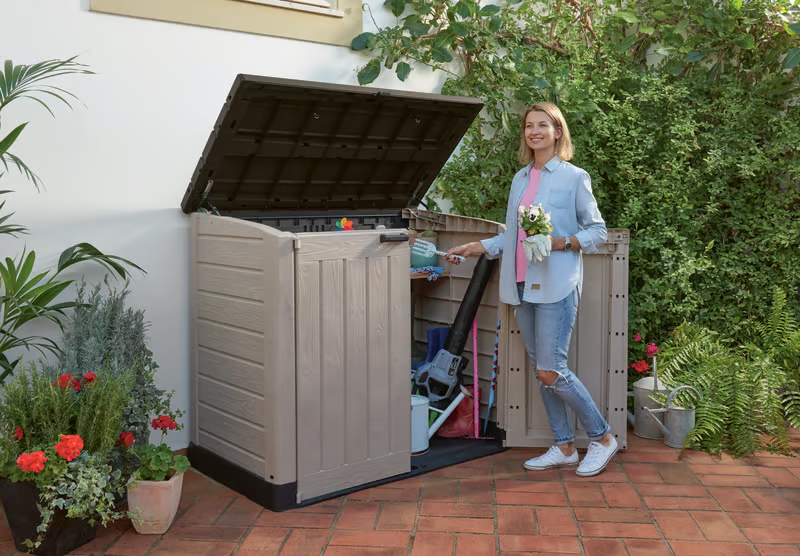
The Max is the most common Keter model in UK gardens. It has a piston-assisted lid for easier opening. Assembly takes 20 to 45 minutes solo, or 15 minutes with two people.
What’s in the Box
- Base frame and floor panel
- Side panels (2)
- Back panel (1)
- Front panel with door bolt housing (1)
- Lid panel (1)
- Piston strut (1)
- Hinge components
- Foot lock components
- Screwdriver-compatible fixings
- Instruction booklet
Assembly Steps
Step 1: Assemble the base frame. The Max has a separate base frame that clips together before the floor panel is installed. Clip the four frame sections together at the corners. Place the floor panel onto the frame and press down at each corner until it clicks.
Step 2: Attach the back panel. Slot the back panel into the rear channel of the base frame. The panel has a top and bottom — the smoother edge goes upward.
Step 3: Attach the side panels. Slot each side panel into the side channels. The panels interlock with the back panel at the rear corner. Press each joint firmly until you feel it seat.
Step 4: Attach the front panel. The front panel carries the door bolt. Make sure the bolt housing faces outward. Click into the side panels at both front corners.
Step 5: Square up and tighten. Before tightening any screws, push all four walls inward gently to ensure all joints are fully engaged (the pieces fit together completely). Tighten the fixings (screws and bolts) from the base up.
Step 6: Attach the lid and piston strut. Place the lid on top. Align the hinge points at the back, then seat the hinge pins (insert the metal rods that hold the hinges in place). Attach the piston strut (hydraulic assist rod) between the inside of the front wall and the underside of the lid. The strut clips into two pre-formed sockets (moulded attachment points). Open the lid to check that the strut fully supports it.
Step 7: Fit the foot lock. The foot lock (a mechanism securing the base of the doors) sits at the base of the front panel. Clip the foot lock bracket (attachment piece) into the pre-formed slot. When closed, both the lid bolt and the foot lock must be engaged for the unit to be properly secured.
Keter Store It Out Ace: Assembly Instructions (1200L)
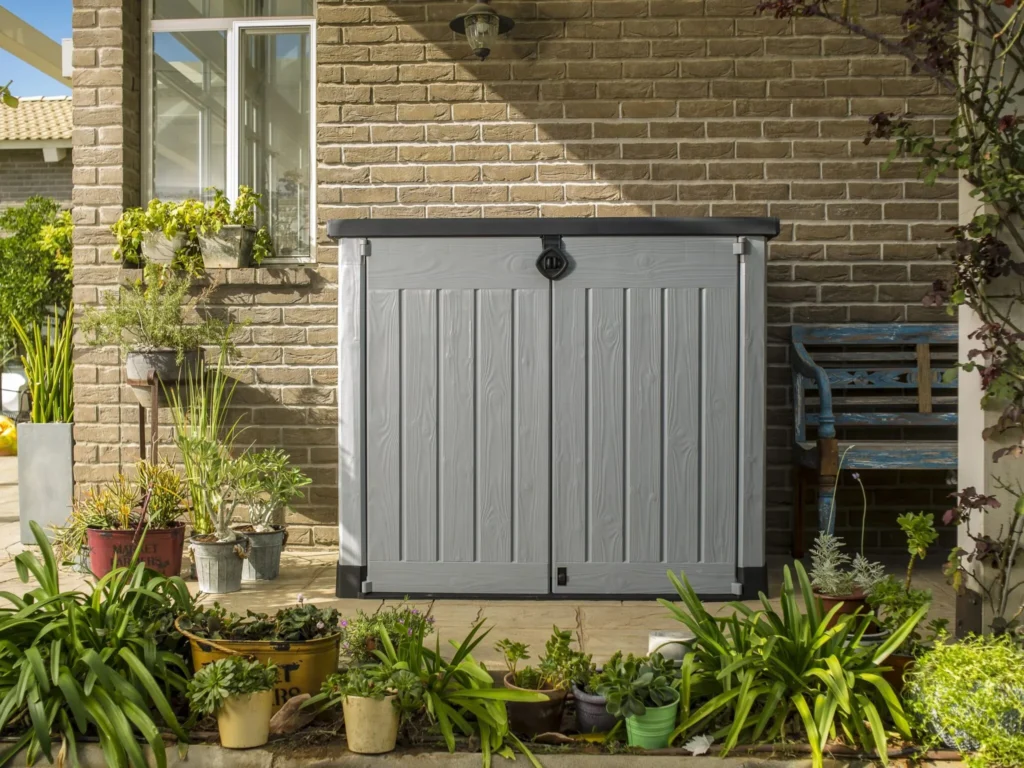
The Ace also holds 1200L like the Max but uses gas struts for smoother lid action. A bevelled door threshold makes it easier to roll wheelie bins in and out. Assembly, similar to the Max, takes 20 to 45 minutes.
Key Differences from the Max
- Gas struts instead of a piston (attach the same way, but the strut is heavier)
- Bevelled front threshold on the base (bin access)
- Ventilation panel built into the rear (helps prevent odours in bin storage)
Assembly Steps
Follow the same sequence as the Store It Out Max above. The main difference is Step 6: the gas struts on the Ace clip into slightly different socket positions. Attach both struts before testing the lid — the lid is heavier on the Ace and will not stay open without both struts in place.
If the lid drops rather than staying open, check that both strut clips are fully seated. A strut that appears clipped but has not fully engaged will allow the lid to fall.
Keter Store It Out Pro: Assembly Instructions (1200L)
The Pro is the premium 1200L model, often available in darker colours and through higher-end retailers. Assembly steps are identical to the Max.
Keter Store It Out Ultra: Assembly Instructions (2000L)
The Ultra is the largest, at about 2000 L. It stores two bins, bikes, or a lot of garden furniture. Assembly takes 45 to 60 minutes and is easier with two people.
What’s Different on the Ultra
- The side panels are significantly larger and awkward to hold on your own.
- The lid is heavier and requires two people to position during hinge fitting.
- The base frame has an additional centre support rail (an extra bar running along the middle to add strength).
- Some variants have a secondary front panel that forms a double-door opening (two doors at the front instead of one).
Assembly Steps
Follow the same base-frame-first sequence as the Max. The critical difference is panel handling: do not attempt to fit the side panels alone if you can avoid it. The Midi, Max, and Ace can all be assembled solo without too much difficulty. The Ultra genuinely benefits from a second pair of hands, particularly for Steps 3, 4, and 6.
If assembling solo, prop the side panels against a wall temporarily while you align the base channel.
Common Problems Across All Models
The lid is not sitting flush when closed. Usually caused by a panel that is not fully seated at one of the lower corners. Open the lid, press each wall joint firmly, then recheck. Often, the front corners are the culprits.
Panels may click out if you tighten screws too early. Remove panels back to the base and start over. Keep all fixings loose until the structure is square.
The strut or piston is not holding the lid open. The clip has not fully engaged. Fully open the lid with your hand supporting it, unclip the strut, and reseat it. You should hear a definitive click when it is properly in.
The lock hasp is not lining up with the lid. The front panel is slightly out of square. Loosen the front panel fixings, push the panel inward at the top, and retighten.
Floor panel flexing is normal for all models. The floor is intended for distributed loads, not for single, heavy items with small footprints. Lay a wooden board inside if needed.
Anchoring and Wind Security
If your Store It Out is exposed, consider anchoring it. Most models have pre-drilled points for ground anchors or bolts. We have a full guide on anchoring Keter sheds, which applies to the Store It Out range.
If You Need to Dismantle Your Store, It’s Out
The panel-and-clip system works in both directions. All Store It Out models can be fully dismantled and reassembled, which makes them practical for renters or anyone who moves house. Our step-by-step guide to dismantling Keter storage boxes covers the process in detail, including tips for storing the panels without losing fixings.
Are Keter Store-It-Out Products Worth It?
If you’re still deciding whether to buy, our honest Keter sheds overview covers the brand’s reputation, common complaints, and how the Store It Out range sits within the wider Keter lineup.
If you’re comparing different types of outdoor storage, our garden storage boxes guide covers alternatives at lower and higher price points.
Frequently Asked Questions
How long does it take to assemble a Keter Store It Out?
The Midi, Max, Ace, and Pro all take 20 to 45 minutes with one person and a screwdriver. The Ultra takes 45 to 60 minutes and is easier with two people for the larger panels. Keter also offers a professional assembly service across most of the UK for around £200 if you’d rather not do it yourself.
Can I assemble a Keter Store It Out on my own?
Yes for the Midi, Max, Ace, and Pro. The Ultra is manageable solo, but the large side panels and heavy lid make it significantly easier for two people. A cordless screwdriver speeds the process up considerably on all models.
What tools do I need to assemble a Keter Store It Out?
A standard Phillips head screwdriver or a cordless screwdriver. No other tools are required. The panels clip together, and the fixings are designed to be hand-tightened with a screwdriver.
Where can I download the official Keter Store It Out instruction manual?
Go to keter.com/en-gb and search for your model under the assembly instructions section. ManualsLib also hosts PDFs for most models. If you bought from Argos, the Argos product support site (argos-support.co.uk) has model-specific PDFs.
Can I move my Keter Store It Out to a new house?
Yes. All models in the Store It Out range are designed to be dismantled and reassembled. See our full dismantling guide for step-by-step instructions.
Is a padlock included with the Keter Store It Out?
No. All models in the range include a padlock hasp or door bolt, but the padlock itself is sold separately. A standard 40mm padlock fits all models.
How much weight can a Keter Store It Out hold?
Keter rates the Max at up to 1,200kg distributed load. The floor panel is designed for items spread across the base, not concentrated point loads. If you’re storing something very heavy in a small area, place a wooden board inside to spread the load.